


1496–1506 – The First Residents
In 1496, Frans van Busleyden, brother of Hiëronymus van Busleyden, buys a house in Mechelen. At that time, the city is the vibrant centre of the Burgundian empire. The presence of figures such as Margaret of Austria makes Mechelen especially attractive to wealthy nobles and senior officials. Frans dies in 1502 and the house passes to his three brothers: Valerius, Gilles and Hiëronymus. The latter will leave his mark on the house more than anyone else.

1506–1518 – Hieronymus the Host
In 1506, Hiëronymus becomes the sole owner of the city palace, and he has ambitious plans for it. He extends the home to create a building with two main wings, a garden, stables, storage space and servants' quarters. The city palace becomes impressive enough to receive distinguished guests, such as Erasmus and Thomas More. They meet in a remarkable room that can still be visited today: the hypocaustum. This small chamber could be heated easily and kept comfortably warm. The greatest treasure is the series of beautiful murals inspired by mythological stories.
In 1517, Hiëronymus van Busleyden dies in Bordeaux when returning from a journey to Spain. His death marks the end of an important chapter in the history of this city palace.

1518–1580 – Destruction and Plundering
In 1518, the city palace passes into the hands of the Le Sauvage family. It remains in their possession for eighty years. However, these are difficult times for Mechelen. In 1546 the Zandpoort explodes, destroying much of the city by fire. In 1572 and 1580, Mechelen is plundered during the Spanish and English Furies. The Burgundian court moves to Brussels, followed by many nobles and senior officials. The owners of Hof van Busleyden stop extending the property, and largely preserve it as it is.

1589–1620 – Changing Fortunes
In around 1600, Mechelen begins to flourish again as a religious centre in the Low Countries. In 1589, the city palace acquires new owners: Karel van Arenberg and Anna van Croy. Both belong to the highest ranks of the nobility. The couple own several residences and only stay in Mechelen from time to time.
In 1609, Hof van Busleyden changes hands again: It's new owners are Jacob van Varick, a member of the Great Council, and his wife Johanna Rovelasca. Unlike their predecessors, they do not belong to the highest ranks of the nobility. They begin by selling parts to the northern side of the building. Ten years after moving in they sell the rest of the property to Wenceslas Cobergher, one of court’s leading artists, who has very different plans for the building.

1620–1828 – Charitable Institution
In 1620, Wenceslas Cobergher opens a Mount of Mercy (Berg van Barmhartigheid) at Hof van Busleyden. People in poverty obtain loans at little or no interest by leaving valuable possessions such as jewellery or books as security. Cobergher founds several Mounts of Mercy in the Low Countries, including one in Gruuthuse Palace in Bruges. As an architect, he designs many of these institutions himself. However, the grand city palace undergoes substantial alterations, including additional security and more storage space. For several centuries, the pawnshop continues to offer relief to those in Mechelen who are struggling financially.

1828–1879 – Children’s Voices and Music
In the 19th century, the city palace continues to serve as a Mount of Mercy. But the pawnshop is facing financial difficulties. To bring in additional income, part of the building is let out. A nursery school opens there in 1828, followed by a music academy in 1869.

1879–1914 – Imaginative Restoration
In 1879, Hof van Busleyden undergoes a major refurbishment, although the work is guided more by aesthetic taste than historical research. The architects add romantic features, including stepped gables, a tulip-shaped spire and wooden dormer windows. These elements are now inseparable from the way we picture the city palace, but they were probably not part of the original building.

1914 – War and Fire
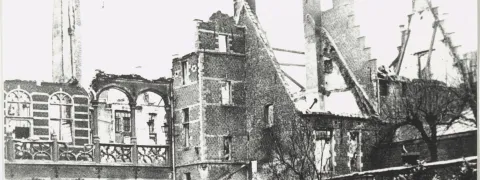
The First World War breaks out in 1914. Heavy shelling between German and Belgian forces causes a devastating fire in Hof van Busleyden. Most of the building is destroyed. Very few original elements survive, and only the walls are left standing. Fortunately, the remarkable murals in the hypocaustum escape destruction. After the war, the city commissions the reconstruction of the palace. The restoration is based on the romanticised 19th-century version of the building.

1938 – 2010 – A Museum is Born
The City of Mechelen decides to create a new city museum in the old city palace, dedicated to telling the story of Mechelen. It is officially opened on 31 July 1938. King Leopold III visits the city that day. A commemorative plaque beneath the eastern gateway still marks the occasion. The city palace is also granted protected monument status in 1938.

2010–2018 – Extending Underground
From the late 1990s onward, the city authorities begin planning a new future for Hof van Busleyden. The old city museum no longer meets the needs of a contemporary audience. Architects David Driesen and Hans Le Compte are appointed to develop the renovation plans. The building work begins in 2010.
The city palace is given a new extension: a state-of-the-art exhibition gallery beneath the large walled garden. This space makes it possible to stage temporary exhibitions, each with its own specially designed installation. The rooms of the palace itself are refurbished, the inspiration taken from the original layout.
2018–2024 – New Gardens, Roof, Windows and Coffee-bar
In 2018, the museum reopens under the name Museum Hof van Busleyden. Over the following years, many thousands of visitors come to enjoy the permanent exhibition, temporary exhibitions and activities.
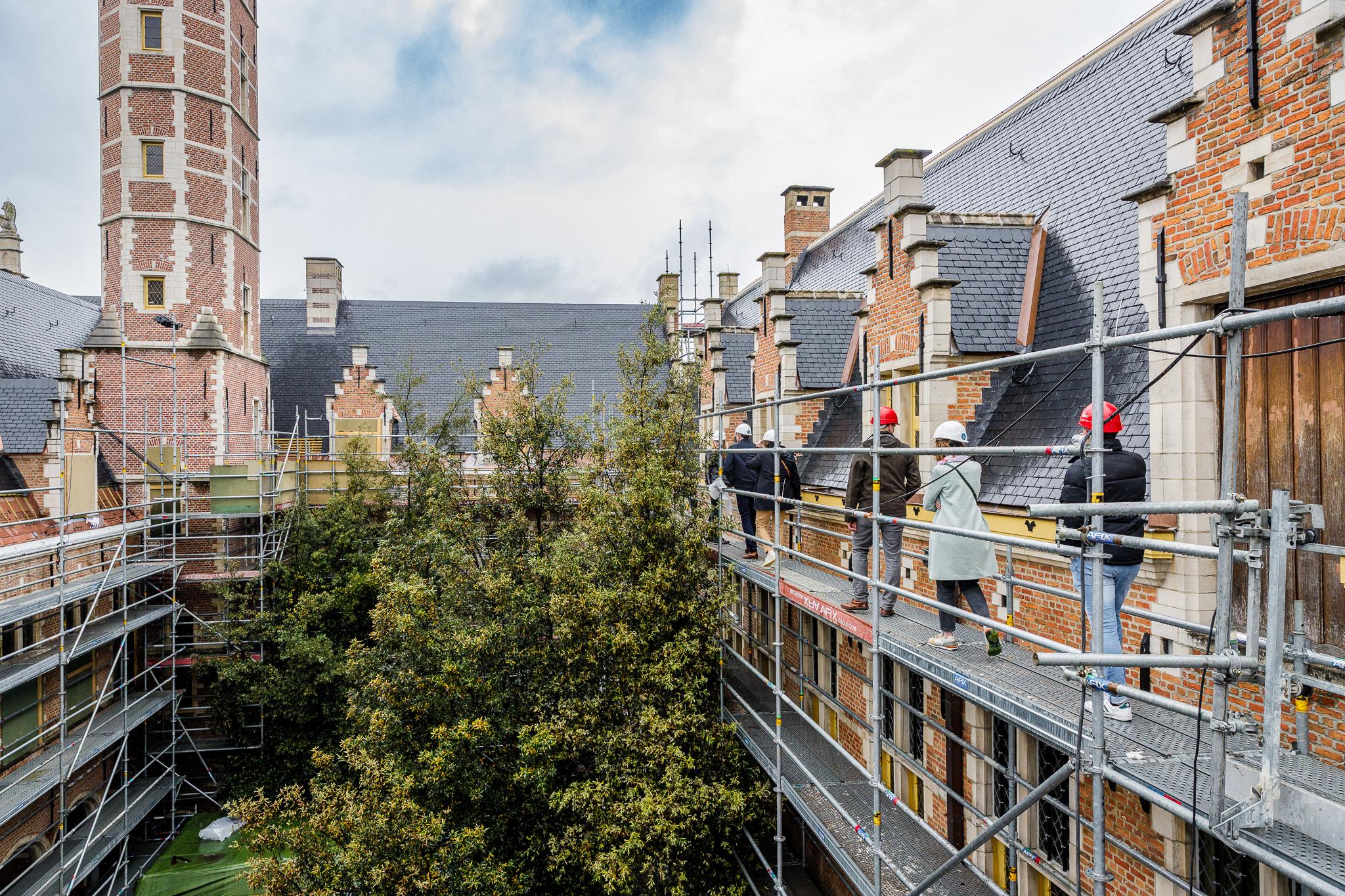
After the extensive restoration of the interior, attention turns to the outside of the building in 2022. During this major conservation project, the city palace receives a new roof, and all its windows and woodwork are restored or replaced. The gardens are de-paved and the planting is redesigned. After standing empty for more than 10 years, the 18th-century corner building known as ‘t Schipke is converted into the coffee-bar.

2024 – Today
Museum Hof van Busleyden reopens in the spring of 2024 with a redesigned permanent exhibition and a renewed focus on the Burgundian-Habsburg period. The museum welcomes visitors into three distinct worlds: the court of Margaret of Austria, the secluded lives of the Hospital Sisters and the world of the palace’s first resident, Hiëronymus van Busleyden.
Share